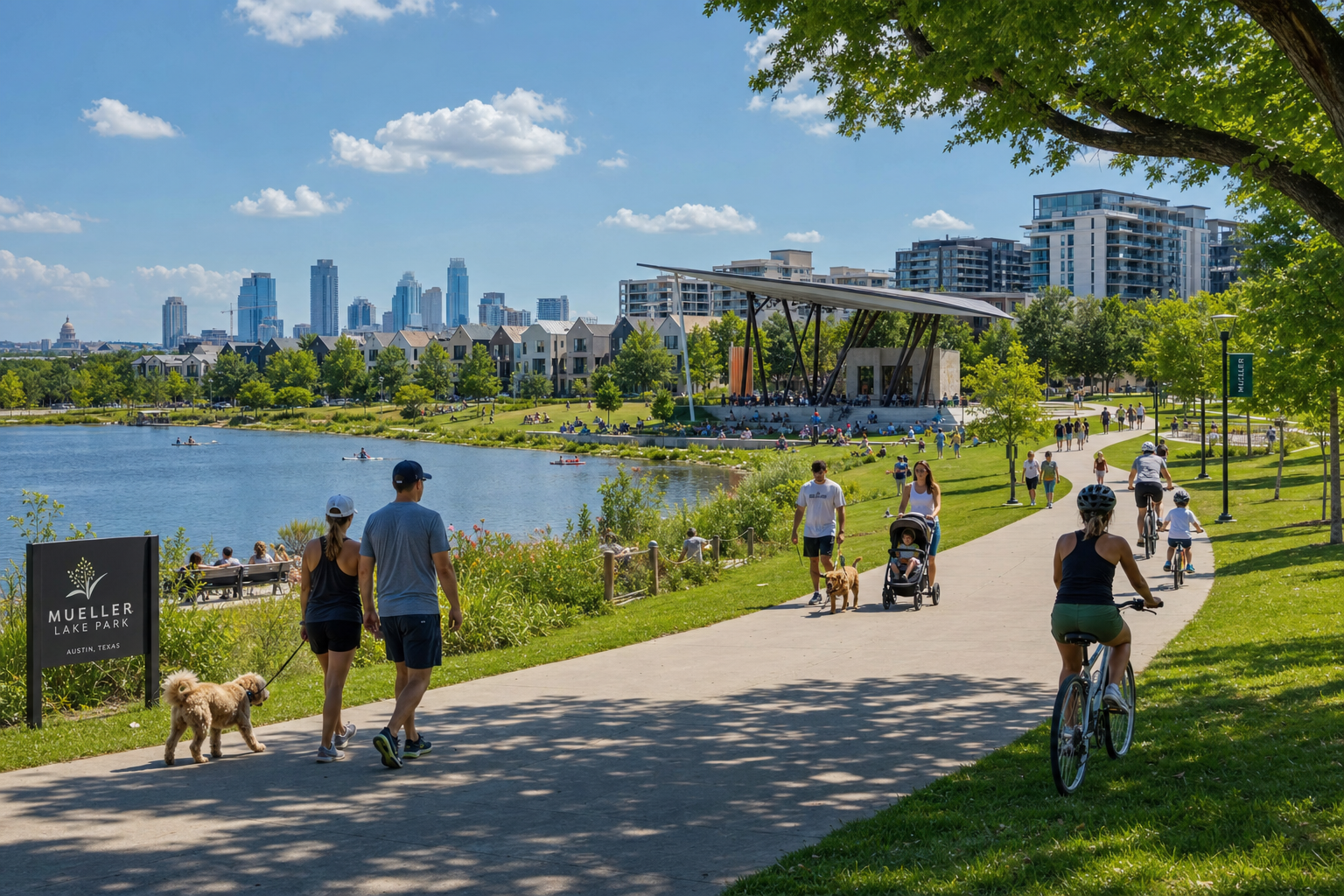
From Airport Runways to Urban Village
Most Austin neighborhoods grew slowly over decades. Mueller was planned. The 711-acre site was home to Robert Mueller Municipal Airport, Austin's first civilian airport, which operated from 1930 until it closed in 1999 when Austin-Bergstrom International opened out east. City growth had gradually boxed the old airport in, and long before it closed, residents were already imagining what a "new town in-town" could look like on that land.
After years of public meetings, the City of Austin partnered with master developer Catellus to build a compact, pedestrian-first, mixed-income community. The first family moved in on Emma Long Street in 2007. Mueller Lake Park opened in 2008, the flagship H-E-B and the Thinkery children's museum arrived in 2013, and the neighborhood has filled in steadily ever since. As of 2026 it is essentially built out, with roughly 4,900 homes and apartments delivered and the last planned park completed in 2025.
The result is a place that feels distinctly un-Austin in some ways: streets on a tight grid, alley-loaded garages, homes close together, and a real town center you can walk to. If that sounds appealing, Mueller may be exactly your speed. If you picture a big Texas yard, it probably isn't.
The Car-Optional Lifestyle
Mueller's whole reason for existing is walkability. About 140 acres, a fifth of the neighborhood, was set aside for parks and greenways, and the design goal was for every resident to live within roughly 600 feet of green space. In practice, that means groceries, coffee, dinner, a movie, and a lakeside walk are all reachable on foot or by bike from most homes.
The green heart is Mueller Lake Park, about 30 acres wrapped in walking trails, with a dog park, a catch-and-release fishing pond, an open-air amphitheater, and big lawns for picnics. It connects to the Southwest Greenway and more than 12 miles of hike-and-bike trails threading through the neighborhood. Mueller consistently ranks among Austin's more walkable areas, though it sits a notch below downtown given its residential layout. If comparing walk scores matters to you, our guide to the most walkable neighborhoods in Austin puts Mueller in context alongside places like Hyde Park and South Congress.
The town center and H-E-B
Aldrich Street is Mueller's main street, a 42-acre district lined with restaurants, cafes, boutiques, fitness studios, and an Alamo Drafthouse dine-in cinema. Anchoring daily life is the 83,000-square-foot H-E-B, one of the chain's most sustainable stores, built into the street grid rather than a suburban parking lot. Plenty of residents walk there for groceries, which is the whole point.
Community events and the farmers market
The Texas Farmers' Market at Mueller runs weekly near the lake and town center, drawing locals for produce, prepared food, and crafts. Add in food truck nights, live music at the amphitheater, outdoor movie nights, and seasonal festivals, and there's genuinely something happening most weekends. The Thinkery museum gives families a rainy-day anchor right in the neighborhood.
Homes and Prices in Mueller
Mueller was built with a deliberate mix of housing types, which is unusual for a single Austin community. You'll find detached single-family "yard homes," attached row homes (essentially townhomes), condos, garden homes, and thousands of rental apartments, all within the same walkable grid.
| Home type | Typical 2026 price range | Notes |
|---|---|---|
| 1-bed condo | ~$375K-$425K | Entry point; median near $392K |
| 2-bed condo | ~$550K-$600K | Median near $577K |
| Row home / townhome | ~$700K-$950K | Median near $847K, 2-3 stories |
| Single-family home | ~$750K-$1.35M+ | Median near $899K |
Overall the Mueller median sits in the mid-$800Ks, running around $445-$459 per square foot, well above the citywide figure closer to $300. You're paying a premium for location, design, and amenities. For a wider look at what your budget buys across the metro, see our Austin homes buyer's guide.
Mueller also runs an affordable homeownership program, with roughly a quarter of homes historically reserved under shared-equity, fixed-appreciation rules, though those units have grown harder to access as the area has appreciated.
HOA and community fees
There's no single Mueller HOA. It's a master-planned community with a property owners association plus product-specific associations. Detached homes typically pay into the master association at a modest annual or quarterly rate, while row homes and condos carry monthly dues (often a few hundred dollars) covering exterior maintenance, shared amenities, and sometimes insurance. Always pull the resale certificate and confirm exact dues per listing before you write an offer.
Schools and Who Thrives Here
Mueller is zoned to Austin ISD. Common assignments include Maplewood, Blanton, or Ridgetop for elementary, and McCallum or Northeast Early College for high school, with high-school zoning split roughly east-west across the neighborhood. The big recent change is General Marshall Middle School, a new AISD campus located right in Mueller that began fully serving grades 6-8 in the 2025-26 school year. Because boundaries have been shifting, confirm any specific address with AISD's lookup tool.
So who actually thrives in Mueller? A few clear profiles:
- Young professionals and remote workers who want walkable dining, coffee, and gyms without a downtown price tag.
- Families who value green space over a big yard, trading a large lot for parks, trails, and the Thinkery a stroll away.
- Downsizers and car-light households who like being able to leave the car parked most days.
Mueller sits within the broader 78723 zip code, so if you're weighing it against nearby areas, our East Austin buyer's guide is a useful companion for comparing prices and vibe just outside the master plan.
The Honest Downsides
No neighborhood is perfect, and Mueller's tradeoffs are real.
Cost. This is a premium micro-market. Between higher home prices, Travis County property taxes, and recurring association dues, the total monthly cost runs well above much of Austin.
Density and "manufactured" feel. Lots are small and homes sit close together by design. Some Austinites love the walkable intimacy; others feel it lacks the organic character of older neighborhoods. Tour it yourself before deciding which camp you're in.
Parking. Homes have alley garages, but street parking near the town center is metered (free on Sundays) and fills up during events, dinners, and farmers market hours. Day to day it's fine for most residents; peak times near Aldrich Street can mean circling the block.
Construction and aging in sync. Buildout is nearly finished, but infill and commercial work continue in spots. And because so many homes went up in a compressed window, they tend to age at the same pace, so budget for maintenance as the earlier phases mature.
Getting Around: Commute and Transit
Mueller's location is one of its strongest cards. Downtown is about three miles away, typically a 10-20 minute drive depending on traffic, and I-35 and US-183 both sit close by for reaching the rest of the metro.
| Destination | Approx. drive time |
|---|---|
| Downtown Austin | 10-20 min |
| UT campus | ~10 min |
| The Domain (tech corridor) | 20-30 min via US-183 |
| Austin-Bergstrom Airport | ~20 min |
Transit is improving but still requires planning. The MetroRail Red Line runs nearby corridors rather than directly through Mueller, so riders need a first-mile connection. Two projects loom large for 2026 and beyond: the massive I-35 Capital Express Central redesign, which will lower the highway and add capped, boulevard-style segments from around Airport Boulevard through downtown, and Austin's Project Connect light rail, which is set to break ground in 2027. Both promise long-term upside for a close-in neighborhood like Mueller, along with construction disruption in the meantime. If you're comparing commute-friendly areas across the metro, our best neighborhoods in Austin guide lays out drive times side by side.
Ready to see what's available? Browse current Mueller listings and start a home search to filter by condo, row home, or single-family and compare it against nearby East Austin homes.
Frequently Asked Questions
Is Mueller a good place to live in Austin?
Mueller is an excellent fit if you value walkability, parks, and being close to downtown, and if you're comfortable with smaller lots and higher density. Residents can reach groceries, dining, a movie theater, and a lake park on foot, which is rare in Austin. The main tradeoffs are cost and a more planned, less organic feel than older neighborhoods. Touring it in person, ideally on both a weekday and a weekend, is the best way to know if it clicks.
How much do homes in Mueller cost in 2026?
The overall Mueller median sits in the mid-$800Ks, or roughly $445-$459 per square foot. Condos start around $375K-$425K for a one-bedroom and $550K-$600K for a two-bedroom, row homes cluster in the high $700Ks to $900Ks, and single-family homes run from about $750K into the $1.3M range. Prices vary by phase, size, and finish, so check current listings for the most accurate picture.
What schools serve the Mueller neighborhood?
Mueller is part of Austin ISD, with elementary assignments commonly including Maplewood, Blanton, or Ridgetop. The new General Marshall Middle School opened inside Mueller and fully serves grades 6-8 as of the 2025-26 year, and high schoolers attend McCallum or Northeast Early College depending on their block. Because zoning has shifted with Marshall's opening, always verify a specific address with Austin ISD before buying.
Do you need a car to live in Mueller?
You don't need a car for many daily errands, since groceries, restaurants, coffee, and parks are all walkable or a short bike ride away. However, Mueller is car-light rather than fully car-free, because MetroRail doesn't run directly through it and reaching jobs across the metro usually means driving. Most households keep at least one car but use it far less than in a typical suburb.
What are the downsides of living in Mueller?
The most common complaints are cost, density, parking near the town center during peak times, and the neighborhood's planned, uniform feel. Homes sit close together on small lots, and street parking around Aldrich Street can be tight during events and dinners. Some buyers also note that homes built in the same era tend to show wear at the same time. None are dealbreakers for most residents, but they're worth weighing against the walkable lifestyle.