How Walkable Is Austin, Really?
Austin as a whole is not a walkable city. The citywide average Walk Score sits around 42, which means most of the metro was built for driving. But the story changes dramatically once you get into the central core. A cluster of neighborhoods inside and just around downtown score high enough that daily errands genuinely don't require a car.
Walk Score rates addresses from 0 to 100. Anything 90 and up is a "Walker's Paradise," 70 to 89 is "Very Walkable," and 50 to 69 is "Somewhat Walkable." Almost every neighborhood in this guide lands in the Very Walkable tier or higher, which is rare for a Texas city.
Here is how the most walkable Austin neighborhoods stack up in 2026:
| Neighborhood | Walk Score | Vibe | Typical price range |
|---|---|---|---|
| Downtown / Rainey | 94 | Urban high-rise | Condos ~$780K–$800K median |
| South Congress (SoCo) | 82 | Eclectic, touristy | Homes ~$900K–$1.1M |
| Bouldin Creek | 82 | Bungalow chic | Homes ~$950K–$1.2M |
| East Cesar Chavez | 78–84 | Creative, dense | Homes ~$650K–$900K |
| Hyde Park | 74 | Historic, leafy | Homes ~$728K–$1M |
| Mueller | 69–70 | Master-planned | Homes ~$650K–$750K |
| Travis Heights | 69 | Quiet, hilly | Homes ~$920K |
| North Loop | 68 | Quirky, vintage | Homes ~$535K median |
| The Domain | 55 | Suburban urbanism | Condos ~$450K–$650K |
Prices reflect mid-2026 listing data and neighborhood ranges. The citywide median sits near $542,000, so walkable central homes carry a real premium. Walkable, amenity-rich pockets tend to run 8 to 15 percent higher than comparable homes in less walkable parts of town.
The Top-Tier Walkable Neighborhoods
Downtown and Rainey Street (Walk Score 94)
This is the only part of Austin that qualifies as a Walker's Paradise. Bars, restaurants, coffee shops, grocery options, and the Ann and Roy Butler Hike and Bike Trail along Lady Bird Lake are all steps away. It is condo-heavy, with a median around $785,000 and price per square foot near $766, the highest in the city. This is the one place where fully car-free living works day to day, especially if your job is downtown. If a lock-and-leave lifestyle appeals to you, our guide to buying a condo in Austin walks through HOA fees, taxes, and what to check before you offer.
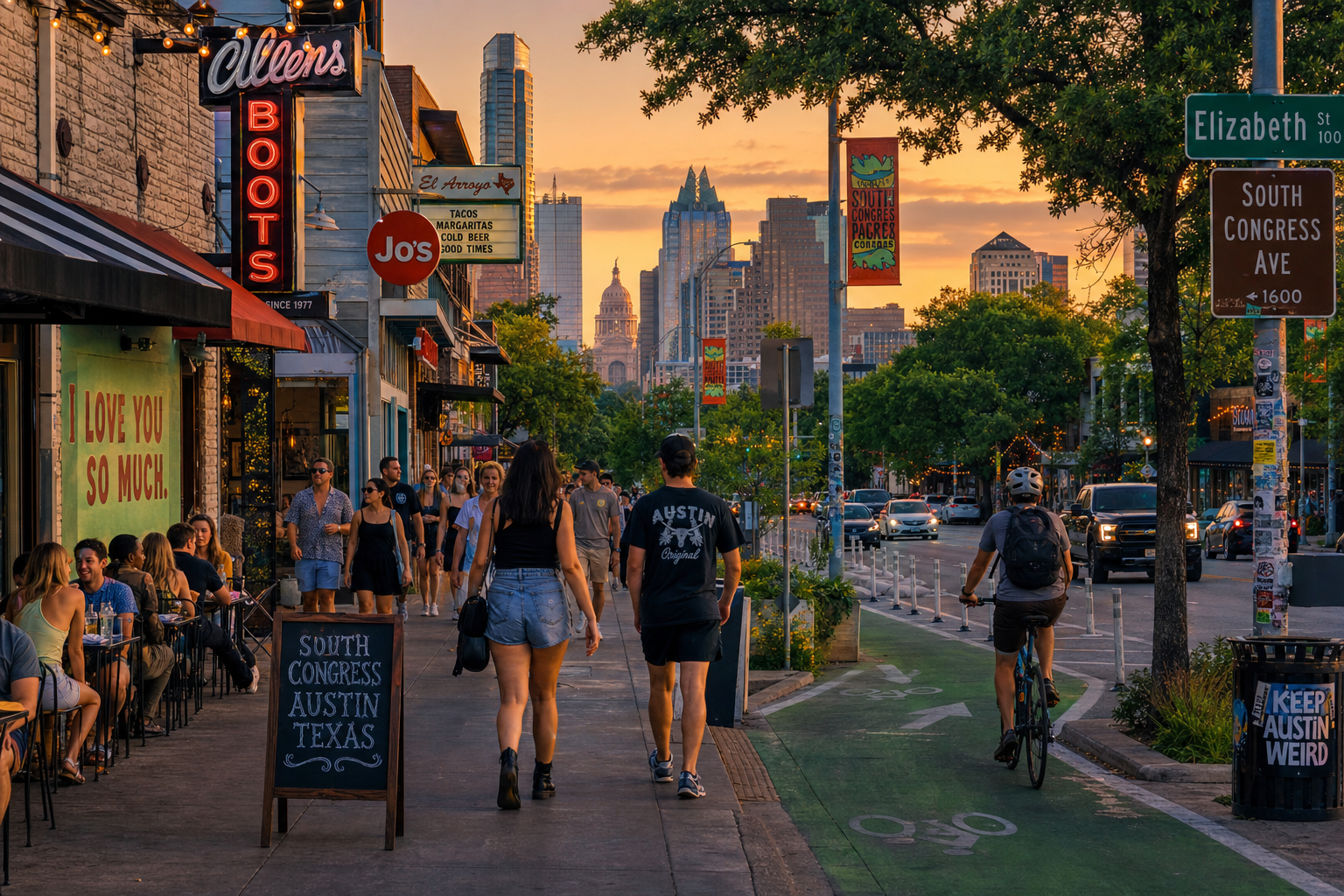
South Congress / SoCo (Walk Score 82)
SoCo is the postcard version of walkable Austin. You can stroll the whole retail strip, hit food trucks, and be at the lake in minutes. Single-family homes commonly land around $900K to $1.1M, with condos and townhomes in the $700K to $900K range. The tradeoff is tourist foot traffic and weekend crowds.
Bouldin Creek (Walk Score 82)
Just west of SoCo, Bouldin is quieter, full of restored bungalows and modern infills. It sits in the coveted 78704 zip, where houses often run $950K to $1.2M. You get the same walkable access to South Congress and Lady Bird Lake with a more residential feel. For the wider south-of-the-river picture, see our South Austin buyer guide.
East Cesar Chavez (Walk Score 78–84)
East of downtown, this is arguably the best value in walkable Austin. Walk Score runs as high as 84 here, with a Bike Score near 96, and it sits about a mile from downtown. Median homes cluster around $650K to $900K, below South Austin. The Plaza Saltillo rail station is walkable, and mixed-use development along East 6th and Cesar Chavez keeps daily needs close. Our East Austin buyer guide digs into the zip-by-zip picture.
The Family-Friendly and Character Options
Mueller (Walk Score 69–70)
Mueller is Austin's clearest example of a designed "15-minute neighborhood." Built on the old airport site, it dedicates roughly 20 percent of its land to parks, so every home is within about 600 feet of a greenspace. You can walk to a full-service H-E-B, the Sunday farmers market, Mueller Lake Park, and the Aldrich Street town center with its restaurants, Alamo Drafthouse, and coffee shops. Homes typically run $650K to $750K, with condos from the $450Ks. It is the top pick for families who want walkability without a $1M price tag. Remote and hybrid tech workers also gravitate here, as covered in our guide to the best Austin neighborhoods for tech workers.
Hyde Park (Walk Score 74)
One of Central Austin's oldest neighborhoods, Hyde Park pairs tree-lined streets and historic homes with walkable commercial nodes along Duval Street. Shipe Park anchors the green space, and Wheatsville Co-op and cafes are an easy walk or bike from most homes. Median sale prices sit near $728,000, with renovated houses pushing toward $1M.
Travis Heights (Walk Score 69)
Tucked east of South Congress, Travis Heights is hillier and quieter, with winding streets and mature oaks. Its Walk Score of 69 puts it just under the "very walkable" line, and its median near $920,000 makes it one of the pricier somewhat-walkable areas. You trade a bit of walkability for calm and charm.
North Loop (Walk Score 68)
North Loop is the quirky, vintage-shop corner of central Austin, with a walkable business strip of record stores, bars, and diners. At a median listing price around $535,000, it is one of the more attainable central options, though the walkable core is small.
The Domain (Walk Score 55)
The Domain is walkable inside its own footprint. You can live in a Domain-area condo (roughly $450K to $650K) and reach shopping, restaurants, gyms, and offices on foot. Step outside the complex, though, and it becomes car-dependent fast, with major roads and pedestrian gaps. It works best as car-light living for people who work nearby.
The Austin Transit Reality Check
Walk Score assumes you sometimes need transit, and this is where Austin still lags. Here is the honest state of things in 2026.
The MetroRail Red Line runs from Leander through North Austin to downtown, and the newer McKalla Station near Q2 Stadium added a North Burnet stop. It is useful for commuters along that corridor but does not blanket the city. CapMetro's Rapid bus lines, including the new Rapid 800 and 837 serving East Austin, reached full frequency in June 2026 and run electric buses, which meaningfully strengthens central and east-side service.
The big promise, Project Connect light rail, is still years out. As of 2026 the project has federal environmental clearance and a pre-construction contract, but no track has been laid. Construction is slated to break ground in 2027, with the first roughly 10-mile, 15-station line, connecting downtown, the University of Texas, and East Riverside, targeted to open around 2033. So if you are buying today for a light-rail lifestyle, you are buying on a promise, not a train.
What actually makes car-light living work now is the bike network. Austin has built out an All Ages and Abilities network of more than 1,200 miles of protected lanes, neighborhood bikeways, and shared-use paths, plus over 300 miles of urban trails. Combine that with CapMetro Bikeshare e-bikes, walkable errands, and occasional rideshare, and daily driving drops sharply in the core.
Where car-free vs car-light is realistic
Fully car-free is realistic downtown, near UT and West Campus, and in the most connected parts of East Austin, especially if your job sits along a strong transit or bike corridor. Everywhere else, plan for car-light: one household car, driven far less than in the suburbs, with bikes and buses covering short and medium trips.
Walkable Urban Living vs the Suburbs
Choosing a walkable neighborhood is really a choice about how you want to spend your time and money. Here is the honest tradeoff.
| Factor | Walkable central Austin | Suburbs (Cedar Park, Round Rock, etc.) |
|---|---|---|
| Price per square foot | High ($400–$766) | Lower ($200–$290) |
| Space for the money | Less | More |
| Daily driving | Minimal to moderate | High |
| Walk to groceries/dining | Yes | Rarely |
| Yard and quiet | Limited | Abundant |
| Schools | Mixed | Often top-rated |
Walkable central living costs more per square foot and gives you less space, but it hands back time otherwise spent in traffic. Suburbs flip that: more house and yard, stronger schools, but a car-centric daily rhythm. For a full breakdown of that decision, see our best Austin suburbs comparison and the complete Austin relocation guide.
If schools drive your search, note that walkable central neighborhoods fall mostly within Austin ISD, so it is worth checking campuses against our guide to the best Austin school districts before you commit.
Start Your Walkable Home Search
The good news for 2026 buyers is that the market has softened citywide, which gives you more room to negotiate even in desirable central neighborhoods. Walkable pockets still command a premium, but you have more inventory and time than buyers did a few years ago.
Decide first whether you want a lock-and-leave condo (Downtown, the Domain, East Austin) or a walkable single-family home (Mueller, Hyde Park, Bouldin, Travis Heights). Then filter your search by neighborhood and property type, and prioritize a specific address's proximity to a grocery store, a park, and a frequent bus line. That trio is what makes car-light living actually work. Browse listings in the neighborhoods above to compare what your budget buys in each.
Frequently Asked Questions
What is the most walkable neighborhood in Austin?
Downtown Austin, including the adjacent Rainey Street district, is the most walkable neighborhood with a 2026 Walk Score of 94, qualifying as a "Walker's Paradise." Restaurants, bars, coffee shops, groceries, and the Lady Bird Lake trail are all reachable on foot. It is the one part of Austin where full-time car-free living is genuinely practical for many residents.
Can you live in Austin without a car?
Yes, but only in a few central areas like Downtown, UT/West Campus, and well-connected parts of East Austin, and it takes planning. You will rely on a mix of walking, biking on Austin's 1,200-plus miles of bike facilities, CapMetro buses and the Red Line, and occasional rideshare. Most people in walkable neighborhoods choose "car-light" living instead, keeping one car but driving far less than suburban households.
Which walkable Austin neighborhood is best for families?
Mueller is the standout for families who want walkability. It was master-planned with about 20 percent parkland, an on-site H-E-B, a farmers market, and a walkable town center, with homes typically in the $650K to $750K range. Hyde Park is another strong family option with historic homes, Shipe Park, and a tree-lined, low-key feel.
When will Austin's light rail open?
Austin's Project Connect light rail is targeted to open around 2033, with construction expected to break ground in 2027. As of 2026 the project has federal environmental clearance and initial contracts but no track laid yet. The first phase is a roughly 10-mile line with 15 stations connecting downtown, UT, and East Riverside, so it should not be your only reason to buy in a given area today.
Are walkable Austin neighborhoods more expensive?
Yes. Highly walkable, amenity-rich Austin neighborhoods typically cost 8 to 15 percent more than comparable homes in less walkable parts of the same area. Central walkable homes often run $400 to $766 per square foot versus $200 to $290 in the suburbs. You pay a premium for the location and lifestyle, but you save on commuting time and often on a second car.