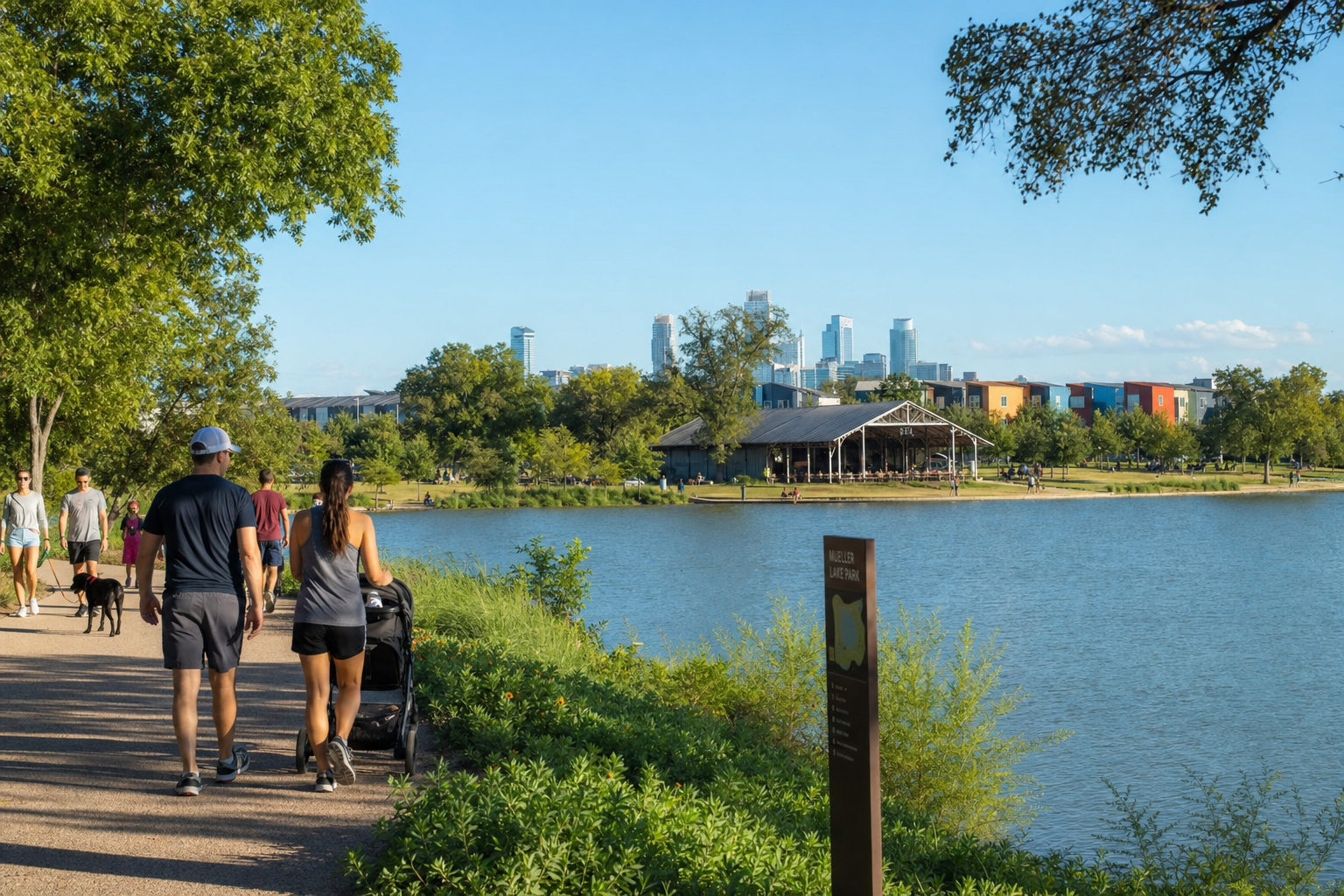
What You Are Actually Paying For in Mueller
Mueller is not a subdivision. It is a 700-acre urban village built on the runways of Robert Mueller Municipal Airport, planned from the ground up so that daily life happens on foot. That design is the whole pitch, and it is what your premium buys.
The core of the neighborhood is Aldrich Street and Mueller Lake Park. Within a 10-15 minute walk of most homes you have a flagship H-E-B, the Alamo Drafthouse with its Barrel O' Fun bar, the Thinkery children's museum, coffee shops, restaurants like Torchy's Tacos and Juiceland, plus banks, salons, and clinics. There is even a regional retail strip along I-35 with Home Depot and Best Buy, so hardware and electronics runs never leave the neighborhood.
Then there is the green space. Mueller has roughly 140 acres of parks and more than a dozen miles of trails. Mueller Lake Park anchors it with a 30-acre spread around a 6-acre lake, an amphitheater, playgrounds, and the Browning Hangar pavilion. Every Sunday from 10 a.m. to 2 p.m., the Texas Farmers' Market sets up there with well over 100 local vendors, a market that has been voted one of Austin's favorites for years running. If you want to understand why Mueller ranks among the most walkable neighborhoods in Austin, spend one Sunday morning walking from your porch to the market and back.
Home Types and 2026 Prices
Mueller was built to hold a genuine mix of housing, which is unusual for Austin. That mix is why prices span a huge range depending on what you buy.
| Home type | Typical 2026 range | What you get |
|---|---|---|
| Condos | Mid-$300Ks to ~$500K | Flats and stacked units, lowest entry point |
| Row homes / townhomes | $550K to $850K | Attached, low-maintenance, walkable core |
| Detached single-family | $850K to $1.3M+ | Porch-forward yard homes, small lots |
| Park-facing / larger homes | $1.1M to $1.5M+ | Premium lots near the lake and greenways |
Neighborhood-level medians bounce around because monthly sales samples are small, but the pattern is consistent: detached homes routinely trade near or above $1 million, while attached product below $600K is almost entirely condos and townhomes. Nearly all of it is newer construction, built roughly 2007 to 2024 to a community green-building standard, so you generally inherit modern systems and better energy efficiency than older central stock. If a condo or townhome is your target, it is worth comparing Mueller against the broader Austin condo market and reviewing how townhomes stack up by area before you commit.
The fee picture you have to budget for
Sticker price is only part of the math in Mueller. Ownership here comes with layers:
- A master Mueller Property Owners Association (POA) assessment that funds parks, trails, pools, and greenways. Recent listings show POA dues around $350 a month, and published ranges run roughly $100-$200 for detached homes and $200-$350 for condos and townhomes.
- A possible building-level sub-HOA if you are in a condo building or townhome cluster, which handles exterior maintenance and insurance for that block.
- A Public Improvement District (PID) assessment on your tax bill, adding roughly $0.15-$0.25 per $100 of value on top of an already high central-Austin tax rate near 2.1 percent.
- A one-time stewardship fee of 0.25 percent of the sale price at closing, plus a community transfer fee.
None of this is hidden, but it adds up. Run the full monthly number, not just the mortgage, before deciding Mueller fits your budget.
Location and Commute
Location is Mueller's quiet superpower. Sitting three to four miles northeast of downtown, it puts you closer to the core than most suburbs while costing less per square foot than a downtown high-rise.
| Destination | Drive time | Alternatives |
|---|---|---|
| Downtown Austin | 10-20 min | ~20-25 min by bike via Boggy Creek greenbelt |
| The Domain / north tech | 20-30 min | MetroRail Red Line from nearby MLK Jr Station |
| UT Austin / Dell Med | 5-10 min | Walkable to Dell Children's for medical staff |
| Austin-Bergstrom airport | ~15-20 min | I-35 south or SH-130 |
The MetroRail Red Line's MLK Jr Station is close enough that residents near it can reach Downtown Station in about 10 minutes of train time, and the same line continues north toward Domain-area stations. Rail times stay steady even when I-35 clogs. That said, most Mueller households still keep a car for the rest of Austin. For a deeper look at how these routes compare, see the wider guide on Austin's best neighborhoods for commuters and where downtown proximity holds up.
The Honest Pros and Cons
Mueller earns real loyalty, but it is not for everyone. Here is the balanced read.
What works:
- True walkability with groceries, dining, a cinema, parks, and a Sunday market inside the street grid.
- Downtown proximity without downtown-condo pricing.
- Newer, energy-efficient homes with fewer near-term repair surprises.
- A strong community culture with constant events, plus economic diversity from the roughly 25 percent of units set aside as income-restricted.
- A comparatively strong central-Austin school pipeline, with well-regarded elementary, middle, and magnet options in the AISD map.
What to weigh carefully:
- Cost. Between price, high taxes, POA dues, and the PID, the total carrying cost is steep and suits higher-income households.
- Small lots. Single-family parcels typically run 0.10-0.20 acre, and homes sit close together. Some residents describe a "fishbowl" feel with limited privacy.
- Density and noise. Active parks, busy sidewalks, and periodic commercial build-out mean this is not a quiet, secluded neighborhood.
- HOA rules. Architectural review governs exterior changes, and the polished, planned look is intentional. If you want big-yard freedom or "Old Austin" quirk, this can chafe.
- Parking can get tight near the commercial core during peak times.
Mueller vs Hyde Park and Other Central Options
The most common decision Mueller buyers wrestle with is Mueller versus Hyde Park, so it is worth drawing the contrast clearly.
| Factor | Mueller | Hyde Park |
|---|---|---|
| Vibe | Master-planned, polished urban village | Historic, eclectic, tree-lined |
| Homes | Newer (2007-2024), mixed types | Older bungalows and craftsman homes |
| HOA | Master POA + sub-HOA + PID fees | No neighborhood HOA |
| Walkability | Integrated town center by design | Charming but more scattered |
| Median (2026) | Wide range; SF often $900K+ | Around $620K, mostly detached |
Choose Mueller if you want new construction, structured walkability, and organized amenities, and you accept the fees that come with them. Choose Hyde Park if you want historic character, mature streets, no HOA, and more freedom to modify your home. Both sit within a 10-20 minute downtown commute, so the decision is really about lifestyle, not location.
If neither fully fits, the surrounding East Austin neighborhoods often deliver similar central access at lower prices, and the broader roundup of Austin's best neighborhoods can help you place Mueller against Tarrytown, North Loop, and other central pockets. Buyers who ultimately land in the seven-figure range may also want to see how Mueller compares within the wider Austin luxury market.
Who Mueller Suits Best
Families who prioritize parks, walkability, and the Thinkery over a big backyard do very well here, provided the budget works. Playgrounds, splash pads, pools, and safe crosswalks are built into the plan, and the school pipeline is strong for a central ZIP.
Professionals, especially in tech and medicine, are the neighborhood's core. Median resident age sits in the mid-30s, commutes to downtown, UT, and Dell Med are short, and the walkable social scene fits an active lifestyle. Many are dual-income households that can absorb the fees comfortably.
Active retirees and downsizers who want low-maintenance, lock-and-leave living near restaurants and trails can love it, though it is a mixed-age, busy place rather than a quiet 55+ enclave.
If any of those profiles sounds like you, the next step is to see what is actually on the market. Browse current Mueller listings, filter by condo, townhome, or single-family to match your budget, and start a home search to compare Mueller side by side with the central neighborhoods that made your shortlist.
Frequently Asked Questions
Is Mueller a good place to live in Austin?
Mueller is one of Austin's most walkable and community-oriented neighborhoods, which is why it earns strong loyalty from families and professionals. You can reach groceries, dining, a cinema, parks, and a weekly farmers market on foot, all three miles from downtown. The trade-offs are cost, small lots, density, and HOA rules. If those fit your priorities, it is an excellent place to live.
How much do homes cost in Mueller in 2026?
Prices depend heavily on home type. Condos generally start in the mid-$300Ks, townhomes and row homes run roughly $550K to $850K, and detached single-family homes often land between $900K and $1.3 million, with park-facing homes pushing higher. Because monthly sales samples are small, published medians swing, but detached homes consistently trade near or above $1 million.
What are the HOA and PID fees in Mueller?
Mueller uses a layered structure. Every owner pays a master POA assessment, roughly $100-$200 a month for detached homes and $200-$350 for condos and townhomes, and many attached homes also pay a building-level sub-HOA. On top of that, a Public Improvement District assessment appears on your tax bill, and a 0.25 percent stewardship fee applies at sale. Budget the full monthly total, not just the mortgage.
How is the commute from Mueller to downtown and the Domain?
Downtown Austin is typically a 10-20 minute drive, or about 20-25 minutes by bike along the Boggy Creek greenbelt. The Domain and north tech corridor run roughly 20-30 minutes by car. The MetroRail Red Line from the nearby MLK Jr Station reaches downtown in about 10 minutes of train time and continues north, offering commute times that stay steady even when I-35 is congested.
Is Mueller or Hyde Park better for buyers?
It comes down to lifestyle. Mueller offers newer construction, a planned walkable town center, and organized amenities, but with POA, sub-HOA, and PID fees. Hyde Park offers historic bungalows, mature tree-lined streets, and no neighborhood HOA, with a 2026 median around $620K. Both keep you within a 10-20 minute downtown commute, so choose based on whether you value polished planning or established character.